What actually matters
Beyond the headline rate, these are the things that determine whether a card reader works for your business.
Connectivity matters
Built-in SIM or Bluetooth to your phone — the right connection depends on where and how you trade.
Battery life
If you're mobile or trading outdoors, battery longevity is more important than screen size.
Portability
Some readers slip into a pocket. Others sit on a counter. The right form factor matches your setup.
Transaction rates
Headline rates aren't everything. Settlement speed, monthly fees, and hidden charges matter too.
Reliability
A reader that drops connections or freezes mid-transaction costs you more than a slightly lower rate.
Room to grow
Start with a card reader now. Move to a POS later if your trade demands it — without switching provider.
Setup levels
Start where it makes sense. You can always step up later.
SumUp Solo
Compact, portable card reader
£79 + VAT
£94.80 inc. VAT. One-off hardware cost. No monthly fees. Free shipping.
- Contactless & chip payments
- Bluetooth — pairs with phone or tablet
- Pocket-sized
- Same-day or next-day settlement
- No monthly fees
- 30-day money-back guarantee
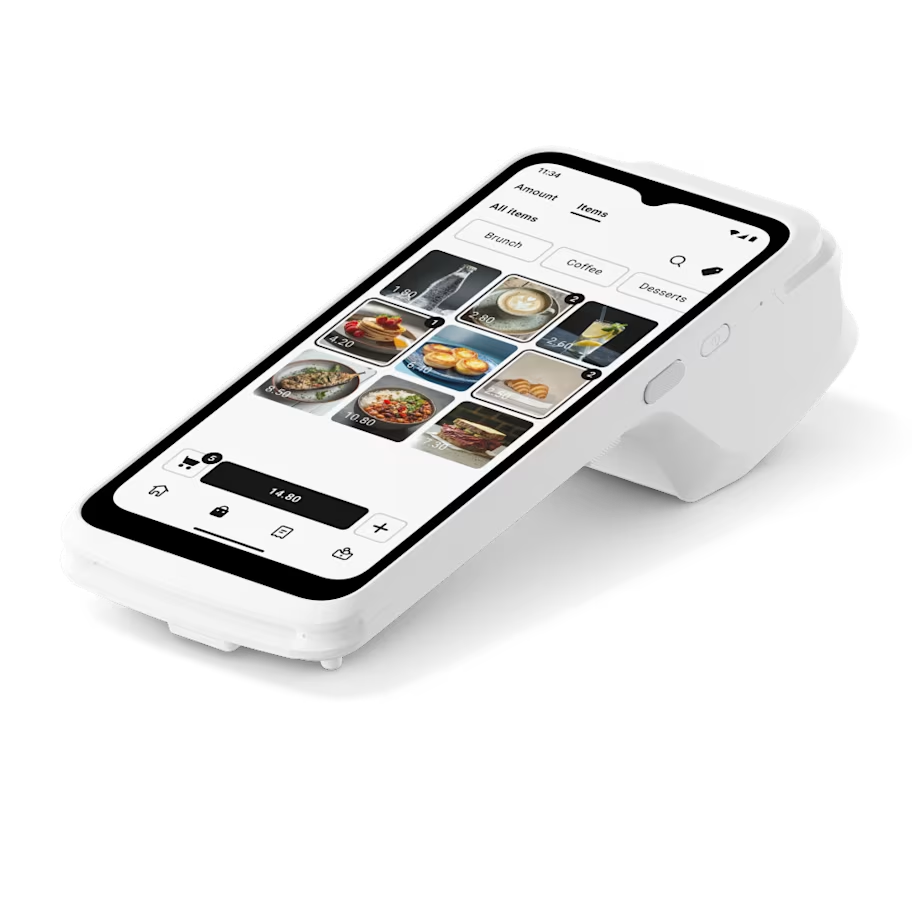
SumUp Terminal
Standalone smart terminal
£135 + VAT
£162 inc. VAT. One-off hardware cost. No monthly fees. Free shipping.
- Built-in SIM — no phone needed
- Touchscreen with receipt printing
- Tipping prompts
- Digital receipts
- Can sync with POS Lite (POS Plus subscription required)
Solo + Counter Printer
Portable reader with counter receipt printer
£109 + VAT
£130.80 inc. VAT. One-off hardware cost. No monthly fees. Free shipping.
- SumUp Solo included
- Counter receipt printer
- Counter checkout setup
- Digital receipts also available
- 30-day money-back guarantee
Card reader or POS?
A quick way to tell which route is right for you.
A card reader is probably enough if…
- You take payments one at a time
- You don't manage a complex menu or inventory
- You trade from a single location or mobile
- You want low cost and simplicity above all
You might need a POS if…
- You manage orders, not just payments
- You route orders to a kitchen or service area
- You need reporting, stock, or staff management
- You serve multiple channels (dine-in, takeaway, delivery)
How it works in practice
Real-world operational scenarios — not fabricated reviews.
Counter payments made simple
A two-chair barber was using cash only because previous card readers were unreliable on the shop's Wi-Fi. They were losing walk-in customers who expected card payment.
What changed
A reader with SIM connectivity solved the reliability issue. No dependence on the shop Wi-Fi, no dropped transactions.
All-day outdoor trading
A weekend market trader needed a reader that lasted a full 10-hour market day without charging, worked on mobile data, and didn't need a phone to operate.
What changed
A standalone smart reader with built-in SIM covered the full day with battery to spare. No phone tethering needed.
Starting simple, scaling later
A new café owner wanted to keep costs low at launch. A full POS felt like overbuying for a 20-cover space with a simple menu.
What changed
A card reader paired with a basic POS app handled payments and gave enough reporting to manage the first six months. They can upgrade to a full POS when they need it.
On-site payments for trades
A mobile plumber needed to take card payments on-site at customer homes. Invoicing after the fact meant delayed payments and admin.
What changed
A pocket-sized card reader with Bluetooth and a smartphone app let them take payment on the spot, with digital receipts sent instantly.