
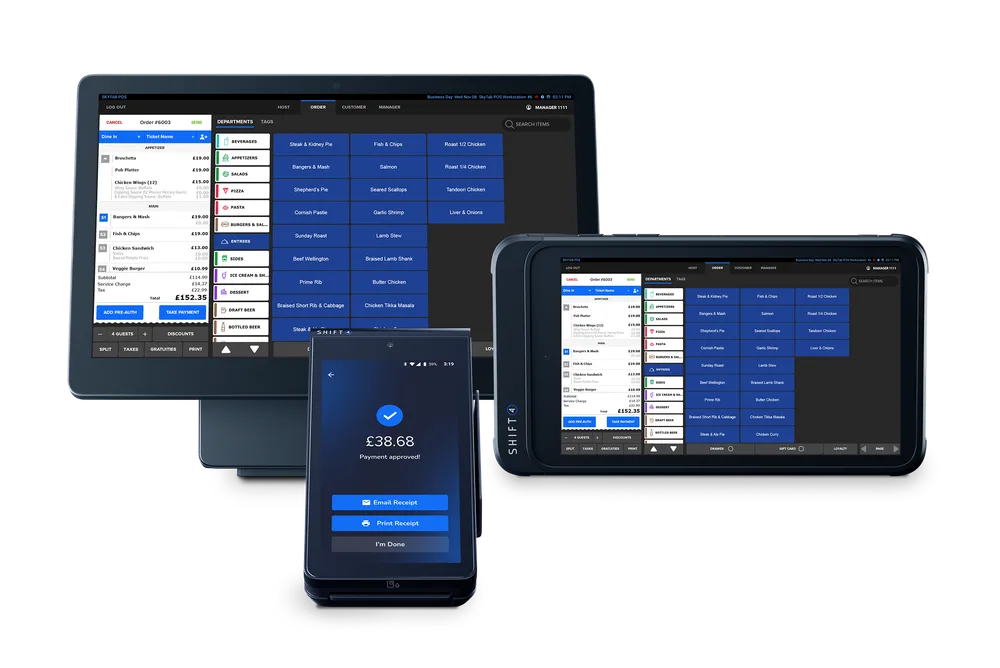
Multi-Site Hospitality

Payment systems for operators running more than one site.

A single-site POS decision is straightforward. A multi-site one is not. The questions change — consistency, visibility, rollout, integration, and who actually owns the relationship when something goes wrong.

This page covers what a sensible multi-site payment infrastructure looks like, what to think about before you commit to any platform, and how an independent advisory approach can make that decision more reliable.

What changes at scale

When you move from one site to two or more, the nature of the decision changes. These are the considerations that matter most.

System consistency across sites

Running different POS setups across different locations creates reporting gaps, training overhead, and operational fragility. The further apart your sites, the more that inconsistency costs you.

Visibility across the estate

Site-level reporting tells you how each location is doing. Estate-level reporting tells you where to focus. Most single-site tools do not consolidate across multiple locations without manual effort.

Delivery and ordering integration

As locations grow, delivery aggregator management becomes more complex. Where you can route aggregator orders into your POS, you reduce dual-screen operation and keep your sales data in one place.

Menu and pricing control

Pushing menu changes, price updates, or promotional offers across multiple locations manually is time-consuming and error-prone. Central menu management is a material operational gain at scale.

Rollout pace and risk

How you deploy a new system matters as much as which system you choose. A poor rollout disrupts trading. A structured one — with training, staging, and support — keeps the risk manageable.

Staff and permissions management

Multi-site operations need role-based access. The ability to manage staff at location level, with oversight at estate level, is a basic requirement that some entry-level systems do not support.

The POS ecosystem question

A POS does more than process payments. At one site, it handles orders and payments. Across multiple sites, it becomes your reporting system, your menu controller, your staff management tool, and possibly your delivery channel manager too.

That changes what you should be asking before you commit. Not just "does it take payments reliably?" but "will this give me visibility across all my sites without adding to my workload?"

The right answer is different for two sites versus ten. But the principle is the same: choose against the business you are building, not just the one you have today.

What to evaluate before committing

Platform capability

  • Central menu management — can you push changes to all sites from one place?
  • Consolidated reporting — can you see all sites in one dashboard without manual exports?
  • Role-based access control — can site managers see their data without seeing everyone else's?
  • Integration options — does it connect to your delivery aggregators, booking systems, or accounting tools?
  • Offline mode — what happens when a site loses internet connectivity?

Commercial and operational

  • Pricing at volume — does the rate improve meaningfully when your estate is treated as a single account?
  • Support model — do you get a named contact, or do individual sites each raise their own tickets?
  • Contract structure — are you locked in site by site, or is the agreement at estate level?
  • Rollout support — is training and go-live support included, or additional cost?
  • Upgrade path — how does the platform handle a new site, a rebrand, or a service model change?

Why an independent review helps at this stage

When you talk to vendors directly, every conversation starts from their product. What they show you is shaped by what they want to sell.

We work differently. We look at how you operate, where the friction is, and what you are likely to need — before we talk to any vendor. That gives you a clear basis for comparing what you are shown.

For a multi-site operator, the wrong choice costs more. A system that works for two sites but not five means a full replacement at exactly the moment your business is growing.

We work with businesses from single sites to growing groups. If the decision feels like it matters, that is a good reason to get an independent view before you commit.

Common questions from multi-site operators

Not necessarily, but it makes life easier. Consistent hardware reduces training time, simplifies support, and means staff can move between sites without relearning the system. Where sites have meaningfully different service models — a kiosk-led counter versus a full table-service floor — different hardware configurations may be justified.

Most modern POS platforms designed for multi-site operation include central menu management — where changes pushed from a head office account propagate to all connected sites. This is one of the clearest operational gains at scale, and something to test explicitly before committing to a platform.

A staged approach typically works best: pilot one site, establish training materials and support processes, then roll out to remaining sites in sequence. Trying to go live across all sites simultaneously increases the risk of disruption and limits your ability to learn and adapt.

Yes, and consolidating to a single provider simplifies reconciliation, support, and rate negotiation. At meaningful volume, a consolidated estate gives you more leverage on pricing than each site negotiating independently.

When the decision affects multiple sites and involves integration requirements, the cost of choosing poorly is higher. An independent review — before you start talking to vendors — gives you a clearer brief, better questions to ask, and a reference point to evaluate what you are being sold.

Thinking about the right system for your next site?

Book a free review. We will look at your operating model and give you an independent view before you start talking to vendors.